In-Wall Doorbell Transformer
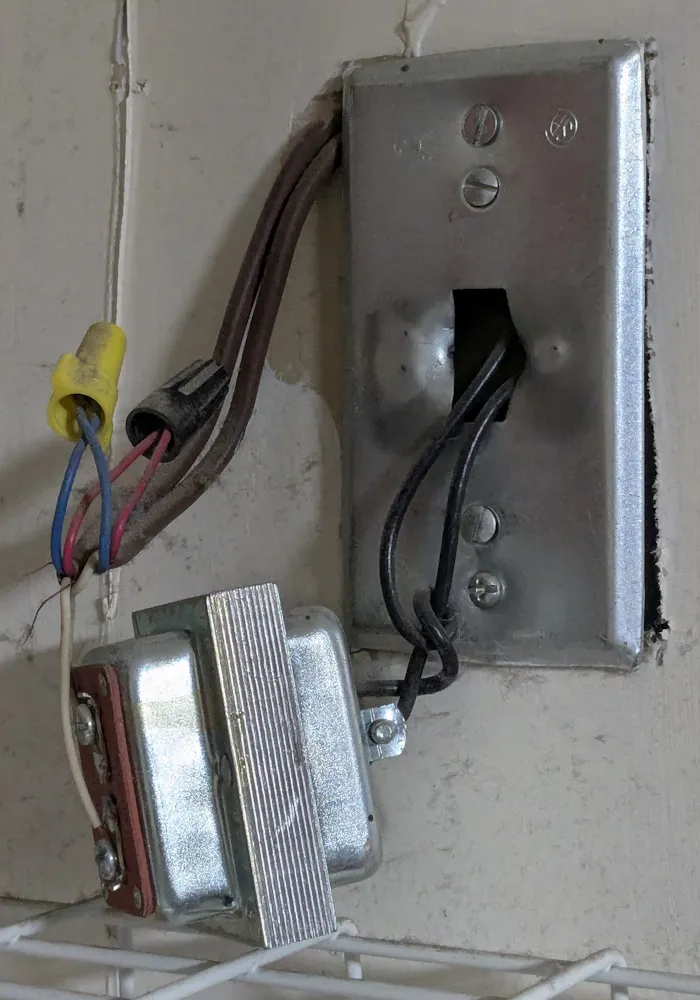
One really puzzling thing to me is how undefined location and mounting of doorbell transformer is in US dwellings. Not only that it has no specificed location but they also have no real mounting specification. Yes, it is specified in NEC they must be separated from high-voltage wires, but other than that is a free-for-all. I’ve seen 1/2" hole, wall box edge screw, and free-style two-screw mounting as most common examples, but you really cannot know for sure until you open it.
For example, my transformer has a nice plate mounting for a square edge mount but the transformer itself is not mounted in. Assuming it was ever mounted properly, by the virtue of sticking out, it was eventually dislodged. And don’t let me even start about low-voltage wires just entering drywall willy-nilly.
Since I wanted to upgrade transformer anyhow, I decided to clean this up. But surprisingly, there are still no real solutions for this. Almost everything I found assumes this transformer is either hanging of the wall or hanging in the wall. It took me a while but I think I found reasonable solution for my use case.
First of all, I wanted it all enclosed in the box. Since NEC forbids high-voltage (110V in this case) wires next to low-voltage ones, I needed one box with multiple compartments. Southwire MSBMMT3G 3-gang box is a rare one that fits my needs. AC side was not actually the problem but most of other dual voltage boxes had 1-gang for high-voltage and 1-gang for low-voltage side. This wouldn’t do in my case since my transformer was bigger than a single “gang” width and I really wanted it fully enclosed as to avoid “fell into the wall” accidents. It’s not ideal mind you since wire-clamps get in the way but it was best I’ve found.
Next task was selection of transformer. My existing one was 16 V so I opted to go with the same. Due to doorbell, I needed a rating of at least 30VA and that finally drove me toward Maxdot 16V 30VA. It has 1/2" hole mounting and it fits into my selected box with a bit of space to spare.
Since I had a 3D printer and voltage monitor display, my thoughts immediately went toward making a custom cover. One of more annoying steps needed to troubleshoot failing transformer is measuring voltage and with a voltage monitor, that would be trivial. And it would look cool.
I went as far as designing the cover and printing it out before remembering the NEC rules. Any cover must also be UL listed and certified for purpose. PLA, being both easily malleable with increasing temperature and fairly flamable is definitely not fit for the purpose. Thus, I ended up with shattered dreams and a plain 3-gang cover.